
Articulation for Singing: The Clarity That Connects 🗣️
“Crisp articulation turns sound into speech—and speech into song.”
Welcome Back: What We’ve Covered So Far
You’ve made it halfway through our Vocal Technique Series—and that’s worth celebrating! 🎉
So far, we’ve explored:
- Posture for Singing – the foundation of your instrument
- Breath Support for Singing – the fuel behind every phrase
- Vocal Freedom for Singing – releasing tension to unlock your natural tone
- Singing Space for Singing – creating resonance that carries
If you’ve been following along, you’ve already built a strong base for healthy, expressive singing. And if you’re joining us mid-series—welcome! You’re in exactly the right place to keep growing.
Coming up, we’ll explore:
🎵 Enunciation, Pitch, Vocal Energy, and Artistic Delivery—the skills that bring music to life.
But for now, let’s focus on a crucial bridge between sound and storytelling: articulation for singing.
Why Articulation for Singing Matters
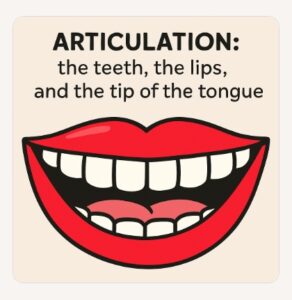
At Harmony Hills Chorus, we believe clarity is kindness. When your audience understands every word, they can connect more deeply to your message. That’s where articulation comes in—the precise shaping of consonants and vowels so your lyrics are clear, expressive, and meaningful.
In ensemble singing, articulation also affects blend. Overly soft consonants blur the text, while overly harsh ones disrupt harmony. The magic happens in balance—crisp enough to communicate, smooth enough to stay musical.
According to the Voice Foundation, articulation depends on how well the lips, tongue, jaw, and soft palate coordinate to form words. When these movements are relaxed and efficient, the text stays clear without tension.
How to Improve Your Articulation for Singing
Here are a few ways to strengthen clarity and precision:
- Consonant Awareness: Practice short phrases emphasizing consonants at the beginning and end of words. Example: “Sing strong songs.” Notice how final consonants give closure and rhythm.
- Tongue Flexibility: Say “red leather, yellow leather” slowly, then faster. This builds agility and helps prevent “lazy tongue” diction.
- Vowel Connection: Sing phrases legato (smoothly) while focusing on connecting vowels—let consonants articulate naturally between them.
- Mirror Practice: Watch yourself as you sing—are your lips and jaw moving naturally, or are they tight? Small visual cues can reveal habits you don’t feel.
“Every word deserves to be understood, and every phrase deserves to be felt.”
The Harmony Hills Approach
During chorus rehearsals, articulation is one of our favorite tools for tightening ensemble sound. A unified approach to diction—especially on consonants—helps barbershop harmony “lock” into that thrilling overtone ring.
When we articulate together, we don’t just sing words—we communicate stories. Every lyric becomes a thread connecting us to the audience and to one another.
At Harmony Hills Chorus, articulation training is woven into warm-ups, sectionals, and performance prep because precision brings polish—and polish creates connection.